
Partial Discharge Testing Services in Chennai – Advanced Diagnosis for HV Equipment
Get reliable partial discharge testing in Chennai to detect insulation faults early and prevent costly electrical failures. Emaar Electricals advanced PD analysis helps identify defects in transformers, switchgear, cables, and motors, ensuring safe, efficient, and long-lasting operation. Trusted by industries for accurate assessment and preventive maintenance solutions.
What is Partial Discharge (PD)
- Partial Discharge is a localized electrical discharge that occurs within the insulation system of high-voltage equipment.
- It does not completely bridge the insulation between two conductors but gradually damages the insulation, leading to breakdown over time.
- PD activity is an early warning symptom of insulation deterioration. Detecting PD at an early stage prevents major failures in transformers, switchgears, cables, and rotating machines.
How PD Testing is useful?
- Insulation deterioration is the primary cause of failure in high-voltage equipment.
- Partial Discharge testing helps in identifying weak insulation points before they develop into catastrophic breakdown.
- It provides condition-based monitoring, avoiding unnecessary shutdowns.
- Helps in extending life expectancy of equipment and reducing unplanned downtime.
Applications of PD Testing
In Power Transformers
- Detects winding insulation weaknesses.
- Identifies voids, cracks, and surface discharges in solid insulation.
- Prevents costly transformer outages by early detection.
In Switchgears
- Detects defects in busbar insulation, joints, and contact systems.
- Identifies surface tracking and corona discharges.
- Helps in preventing switchgear flashovers and arc faults.
In Power Cables
- Locates weak spots, joints, and terminations.
- Identifies void discharges in cable insulation.
- Prevents failures in underground transmission and distribution networks.
Typical Scope of Study
- Verification of compliance with relevant standards (IEEE).
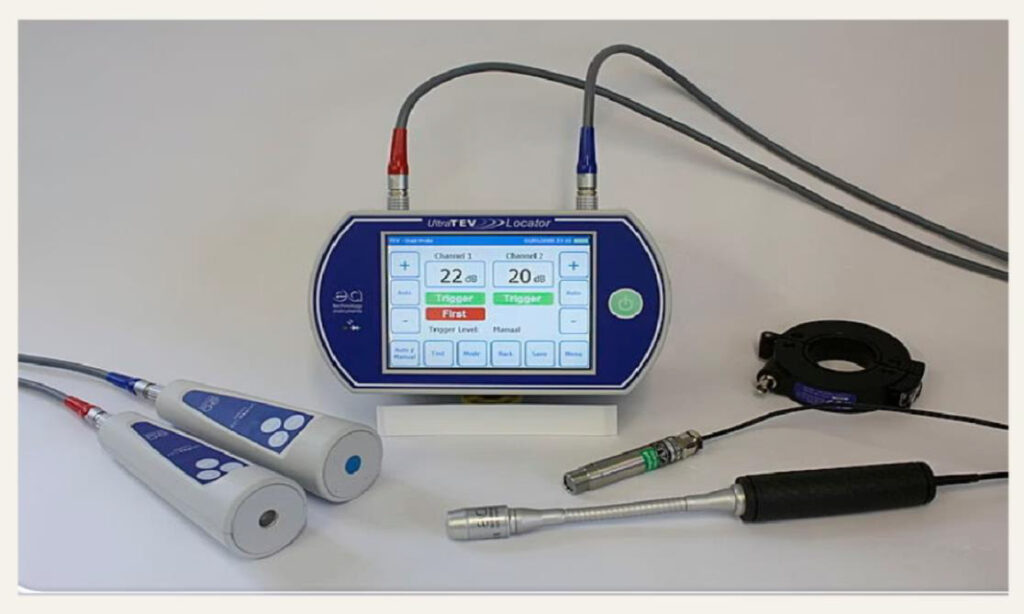
- Continuous monitoring of PD signals during normal operating conditions.
- Phase-resolved PD (PRPD) analysis to classify defect types.
- Localization of PD activity using multiple sensors.
- Trending and risk assessment for prioritizing maintenance.
- Recommendations for corrective action (repair, replacement, or continued monitoring)
Methodology
- Pre-Test Assessment: Collect equipment history and operating conditions.
- Testing: Online PD measurement during operation
- Analysis: Identify the source and severity of PD activity.
- Discussion: Preliminary findings shared with operations and maintenance teams
- Reporting: Provide condition assessment, risk level, and recommendations for corrective actions.